We introduce Soft Speakers, a systematic approach for designing custom fabric actuators that can be used as audio speakers and vibro-haptic actuators. Digitally-embroidered with e-textiles, we implement Soft Speakers as tactile, malleable and aesthetic designs to be part of wearables, soft furnishing and fabric objects. We present
a rapid technique for the DIY fabrication of audio feedback into soft interfaces. We also discuss and evaluate 7 factors for their paramet-
ric design in additive and constructive methods. To demonstrate the feasibility of our approach and the breadth of new designs that it enables, we developed 5 prototypes: 3 wearables, a piece of furniture and a soft toy. Studying Soft Speakers with maker-users expanded the design space, empowering users and supporting in-
clusive design. Our study includes insights on user experience of real-world interactive applications for remote communication, e-learning, entertainment, navigation and gaming, enabled by Soft Speakers’ customizable and scalable form factor.
This research is published at TEI ’21 here: https://dl.acm.org/doi/10.1145/3430524.3440630

Soft Speakers: digitally embroidered audio and haptic actuators on fabrics in three steps: 1) Digital design of the speaker pattern using Adobe Illustrator or Artistic Digitizer Software, 2) Digital fabrication using conductive thread in a digital embroidery machine; 3) Implementation into soft interfaces and wearables

The motivation for Soft Speakers is to expand audio and haptic feedback to the scope of soft interfaces, wearables and soft furnishing.
Soft Speakers using: a) hand-embroidery (1-4 hours); b) mechanical sewing machine (20-40 min); and c) digital sewing machine (2-4 min); and d) the arithmetic spi-
ral pattern


Examples of geometric, organic and animated spiral patterns for soft speakers and vibro-haptic actuators

Illustration of the Soft Speaker circuit consisting of the embroidered layer hiding a magnet underneath and connected to an audio cable through an amplifier that is powered by a rechargeable LiPo battery.
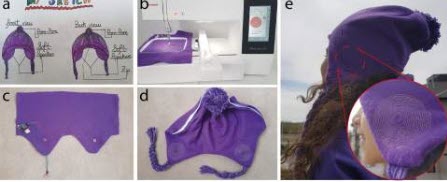

The making of the Talking-Tuque: a) Sketching the design; b) Digital embroidering Soft Speakers; c) Stitching the audio amplifier circuit to the fabric; d) Sewing the layers together with zippers and some embellishment; and e) The hat worn in winter on either face
The making of the Tectonic-Tshirt: a) user sketch; b) pattern design; c) and d) digital-embroidery of Soft Speakers as part of the whole design; and e) wearing the t-shirt with Soft Speakers while gaming for personalized sounds
and vibrations.
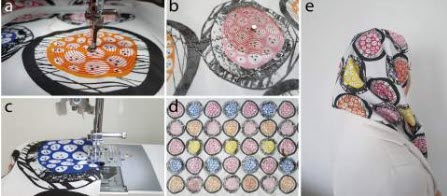
The making of the Sound-Scarf: a) digital embroidery of arithmetic spirals; b) attaching the magnets; c) sewing the scarf; d) stitching the amplifier circuit; and e) wearing the Sound-Scarf and listening to the Soft Speakers.
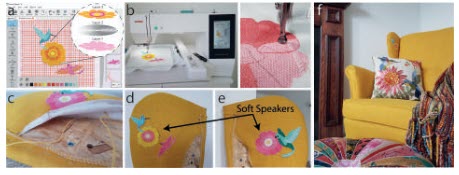
The making of the Listening-Chair: a) Digital design; b) Embroidering Soft Speakers; c) connecting the speakers to the circuit; d) and e) Testing left and right sides/channels; and f) Living with it at home.

The making of Teacher-Teddy: a) Child sketch; b) Embroidering a Soft Speaker; c) Utilizing a DIY bear-making kit; d) Stuffing the circuit; e) e-learning with Teacher-Teddy.
Acknowledgement of Funding
We would like to thank our participants who generously contributed their time and ideas to this study. We would also like to thank our reviewers for their insights that helped to improve this work. This work was funded by the National Sciences and Engineering Research Council of Canada (NSERC) through a Discovery grant
(2017-06300), a Discovery Accelerator Supplement (2017-507935), by the Ministry of Ontario through an Early Researcher Award (ER15-11-101), and a Mitacs Research Training Award.