The world is promoting inclusion and diversity more than ever before. Many people have dual-identities that they alternate between and may often blend. In our design research we explore everyday objects and the role of technology to accommodate people’s needs and personalities. Can furniture change its shape to reflect our dual-identities? Can our interior spaces reveal their hidden aesthetics when interacting with us? We designed a set of matching interactive furniture to unfold these narratives. Our Peace Table and Peace Painting change colour with proximity to reflect the dual identity of Western-Muslims. This pictorial describes our design concept and process with the aim of encouraging the HCI community to design for experiential artwork. Such interactivity can enrich and add new dimensions to the quality of living experience by merging technology into home decor in calm, ubiquitous and non-intrusive ways.
This research is published at TEI ’20 here: https://dl.acm.org/doi/10.1145/3374920.3375006
INSPIRATIONS
This project was inspired by prior work ininteractive furniture and calm appearance-changing artwork to explore people’s livingpractices around everyday objects. However, our approach was not to develop new
technology or use expensive fabrication methods, but to utilize low-cost materials and accessible making and crafting DIY techniques.
INTERACTIVE TABLE
The History Table-cloth [3] that changes illuminating patterns with pressure sensors inspired us to make an interactive table that responds to people’s physical interaction
but in low-cost materials. Thus, we hacked an IKEA LACK side table (oak effect, 55×55 cm) into an interactive table that features dual-identity artwork engraved using a laser-
cutter and at the same time changes colour with proximity, then fades off slowly over time.
INTERACTIVE PAINTING
Inspired by the Anabiosis [13] painting that changes its colour in response to touch and Transience [14] Japanese calligraphy that uses chromogenism to show dynamic aesthetics, our design concept was to create a wall painting that responds in the same way but with a deeper significance. Therefore, we hacked an IKEA RIBBA Frame (white, 50×50 cm) into an interactive wall painting that features dual-identity artwork (matching the interactive table) hand-painted in layers that change colour slowly to reveal hidden calligraphy messages.


Making of the Peace Painting
The Peace painting is designed in layers as shown:
- IKEA RIBBA Frame (white, 55×55 cm) as a neutral modern look that holds the painting layer together.
- A laser-cut arabesque border (plywood, 50×50 cm) giving the picture frame an Arabic style and a customized character.
- Mounting board (white cardboard mat) with wide aperture emphasizing the painting and the artwork.
- Colour-changing artwork using Arabic Gold ink (Layer 1) and thermochromic paint (Layer 2) on cartridge drawing paper (160 gsm).
- An inner frame that gives thickness providing room for the battery and electronic components to be entriely inside the picture frame with no external parts.
- Bottom Layer carrying the electronic circuit including an Arduino microcontroller with 2 MOSFET-enabled 5V heating pads that are powered by an 11.1V LiPo battery.
- Frame back holding all the layers together with flat nails and fitting a capacitive sensing layer of aluminium foil connected to 1 MΩ resistor on the microcontroller
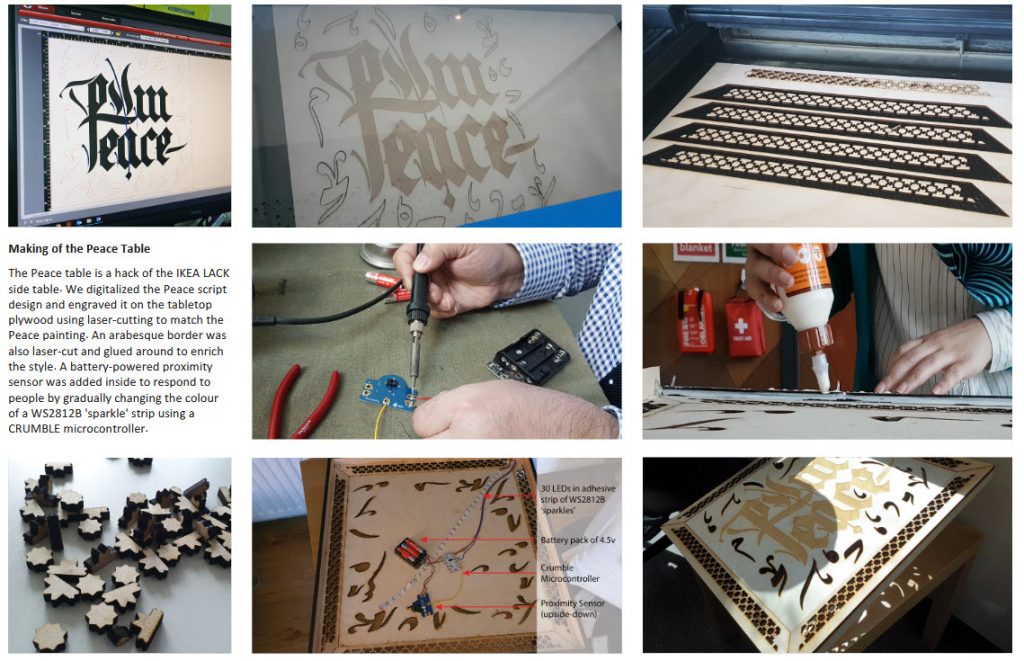
Making of the Peace Table
The Peace table is a hack of the IKEA LACK side table. We digitalized the Peace script design and engraved it on the tabletop plywood using laser-cutting to match the
Peace painting. An arabesque border was also laser-cut and glued around to enrich the style. A battery-powered proximity sensor was added inside to respond to
people by gradually changing the colour of a WS2812B ‘sparkle’ strip using a CRUMBLE microcontroller.
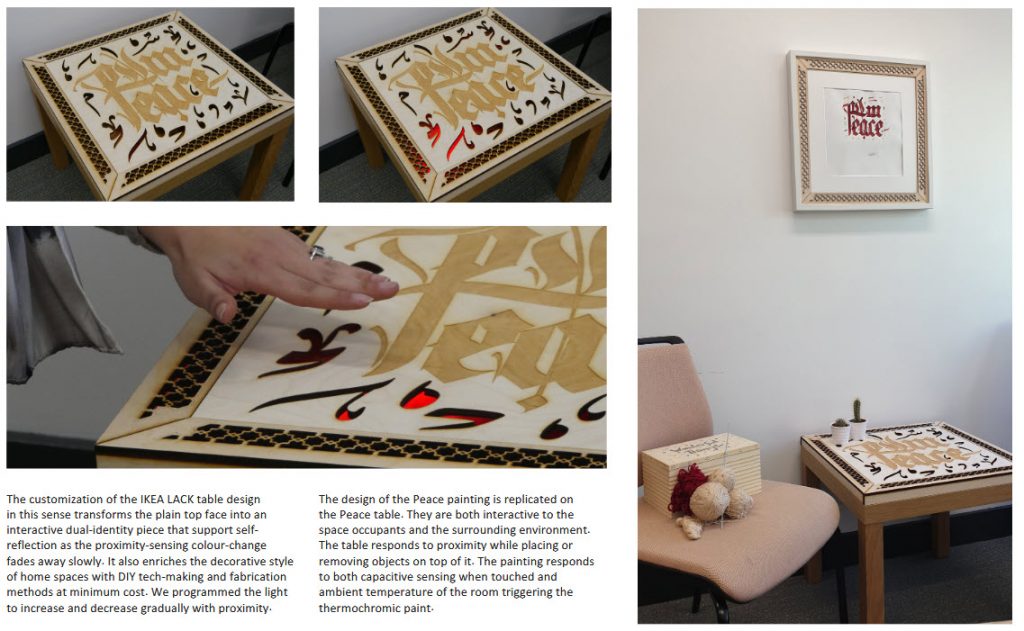
The customization of the IKEA LACK table design in this sense transforms the plain top face into an interactive dual-identity piece that support self-reflection as the proximity-sensing colour-change fades away slowly. It also enriches the decorative style of home spaces with DIY tech-making and fabrication methods at minimum cost. We programmed the light to increase and decrease gradually with proximity.
The design of the Peace painting is replicated on the Peace table. They are both interactive to the space occupants and the surrounding environment. The table responds to proximity while placing or removing objects on top of it. The painting responds to both capacitive sensing when touched and ambient temperature of the room triggering the thermochromic paint.
Acknowledgement of Funding
We would like to deeply thank Jan Kučera and Mohamed AbdelAziz for their support in making our ‘peace’ pieces in addition to all our participants whose feedback formed the experiential outcomes of this work