The prototyping process for e-textile circuits presents unique challenges, as traditional electronic prototyping tools are often rigid and incompatible with the flexible nature of fabric. In this paper, we document the iterative design of FabricBoards, a set of fabric-based breadboards designed for e-textile LED circuits. FabricBoards reimagine the solderless breadboard in a textile-based form, using tools and materials native to textile crafting, inviting and accessible to historically underrepresented makers. We experimented with various textile crafts including machine-sewing, felting, knitting, crocheting, digital embroidery, and weaving a breadboard. Our user study with 18 participants consisted of group workshops for ideation and individual interviews. A thematic analysis revealed four themes on the user experience of FabricBoards in terms of familiarity, materiality, and layout; the inherent incompatibility of electronic components with textiles; and the curiosity and engagement that FabricBoards evoke. Finally, we reflect with generalizable insights on computational making when reimagining e-textile breadboards.
This research is published at CHI ’26 here: https://labs.cs.queensu.ca/istudio/wp-content/uploads/sites/12/2026/04/FabricBoards-Utilizing-Craft-Techniques.pdf

a) Existing e-textile kits lack fabric-friendly breadboards and rely on alligator clips, making fabric-based circuits difficult to design or troubleshoot. b) Our approach explores the design of ‘FabricBoards’ for prototyping and testing wearable components that lower the barrier to entry for beginners and novices. c) Our RtD journey experiments with various textile crafts for creating fabric-based breadboards through machine-sewing, quilting, weaving, knitting, felting, and embroidering.
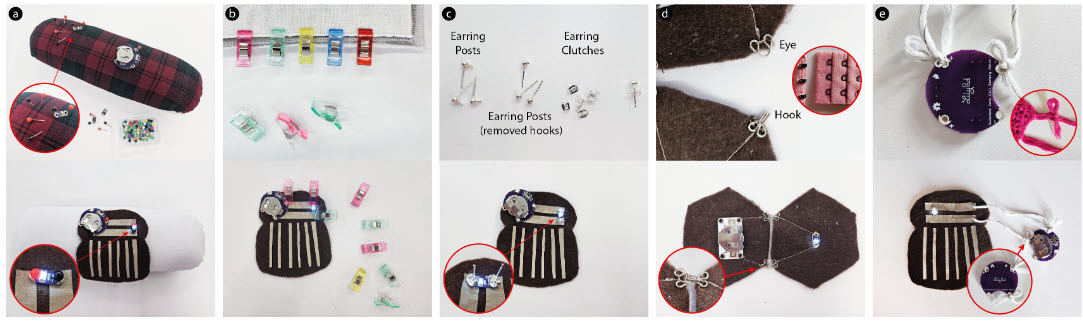
Experimenting with connection methods that are fabric-friendly, including: (a) pins on ironing cushions, (b) sewing clips, (c) earring posts and studs, (d) hooks and eyes, and (e) release knots.


Designing fabric-friendly (a) male-male connection wires and (b) multimeter probes. Our novel connectors replace alligator wires that damage textiles (with sharp teeth, weight, and tensile force) using standard sewing clips soldered to soft silicone wire.
Machine-sewn FabricBoards: (a) FB1.1 with a switch, sewn LEDs and other hooked LEDs; b) FB1.2 with a cleaner design and wider range of motion; c) FB1.3 supports RGB LEDs through a microcontroller.

Workshop materials: a) LED circuit demo using a regular breadboard; b) Activity 1 kit (alligator wires and sewable components); c) Activity 2 kit (e-textile tools and samples), and d) Activity 3 ideation prompt cards.

Participants engaging in: (a) Activity 1, using alligator clips to create an e-textile LED circuit; (b,c) Activity 2, using the three FabricBoard variations, and (d) Activity 3, ideating their own fabric-based prototyping tools or application.

Participant GridBoard designs (Activity 2): a) smiley face (W1), b) “Jerry” (W3), and c) tulip flower (W4).
The Embroidered Braille: Towards Accessible and Inclusive Educational Tools and Everyday Applications is published at CHI ’26 here: https://labs.cs.queensu.ca/istudio/wp-content/uploads/sites/12/2026/04/FabricBoards-Utilizing-Craft-Techniques-1.pdf
The Demonstrating Fabric-Based Breadboards as Women-Centered Prototyping Tools for E-Textile LED Circuits is published at CHI ’26 here: https://labs.cs.queensu.ca/istudio/wp-content/uploads/sites/12/2026/04/Demonstrating-Fabric-Based-Breadboards.pdf
Acknowledgement of Funding
We thank all individuals who participated in our user study. This project was funded by the Natural Sciences and Engineering Research Council of Canada (NSERC) Discovery Grant (2021-04135) and the Queen’s Research Initiation Grant (RIG). The iStudio equipment was funded by the Canada Foundation for Innovation – John R. Evans Leaders Fund (CFI-JELF: 41215), Ontario Research Fund,and the NSERC RTI (Research Tools and Instruments) Grant (2021-00079).